
MCB (Miniature Circuit Breaker)
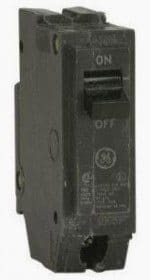
CHARACTERISTICS
- Rated current not more than 100 A.
- Trip characteristics normally not adjustable.
- Thermal or thermal-magnetic operation.
MCCB (Moulded Case Circuit Breaker)
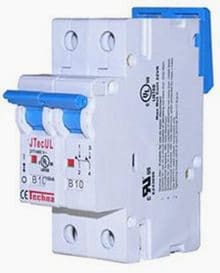
CHARACTERISTICS
- Rated current up to 1000 A.
- Trip current may be adjustable.
- Thermal or thermal-magnetic operation.
Air Circuit Breaker
CHARACTERISTICS
- Rated current up to 10,000 A.
- Trip characteristics often fully adjustable including configurable trip thresholds and delays.
- Usually electronically controlled—some models are microprocessor controlled.
- Often used for main power distribution in large industrial plant, where the breakers are arranged in draw-out enclosures for ease of maintenance.
Vacuum Circuit Breaker
CHARACTERISTICS
- With rated current up to 3000 A,
- These breakers interrupt the arc in a vacuum bottle.
- These can also be applied at up to 35,000 V. Vacuum circuit breakers tend to have longer life expectancies between overhaul than do air circuit breakers.
RCD (Residual Current Device / RCCB(Residual Current Circuit Breaker)

CHARACTERISTICS
- Phase (line) and Neutral both wires connected through RCD.
- It trips the circuit when there is earth fault current.
- The amount of current flows through the phase (line) should return through neutral .
- It detects by RCD. any mismatch between two currents flowing through phase and neutral detect by -RCD and trip the circuit within 30Miliseconed.
- If a house has an earth system connected to an earth rod and not the main incoming cable, then it must have all circuits protected by an RCD (because u mite not be able to get enough fault current to trip a MCB)
- RCDs are an extremely effective form of shock protection
The most widely used are 30 mA (milliamp) and 100 mA devices. A current flow of 30 mA (or 0.03 amps) is sufficiently small that it makes it very difficult to receive a dangerous shock. Even 100 mA is a relatively small figure when compared to the current that may flow in an earth fault without such protection (hundred of amps)
A 300/500 mA RCCB may be used where only fire protection is required. eg., on lighting circuits, where the risk of electric shock is small.
Limitation of RCCB
- Standard electromechanical RCCBs are designed to operate on normal supplywaveforms and cannot be guaranteed to operate where none standard waveforms are generated by loads. The most common is the half wave rectified waveform sometimes called pulsating dc generated by speed control devices, semi conductors, computers and even dimmers.
- Specially modified RCCBs are available which will operate on normal ac and pulsating dc.
- RCDs don’t offer protection against current overloads: RCDs detect an imbalance in the live and neutral currents. A current overload, however large, cannot be detected. It is a frequent cause of problems with novices to replace an MCB in a fuse box with an RCD. This may be done in an attempt to increase shock protection. If a live-neutral fault occurs (a short circuit, or an overload), the RCD won’t trip, and may be damaged. In practice, the main MCB for the premises will probably trip, or the service fuse, so the situation is unlikely to lead to catastrophe; but it may be inconvenient.
- It is now possible to get an MCB and and RCD in a single unit, called an RCBO (see below). Replacing an MCB with an RCBO of the same rating is generally safe.
- Nuisance tripping of RCCB: Sudden changes in electrical load can cause a small, brief current flow to earth, especially in old appliances. RCDs are very sensitive and operate very quickly; they may well trip when the motor of an old freezer switches off. Some equipment is notoriously `leaky’, that is, generate a small, constant current flow to earth. Some types of computer equipment, and large television sets, are widely reported to cause problems.
- RCD will not protect against a socket outlet being wired with its live and neutral terminals the wrong way round.
- RCD will not protect against the overheating that results when conductors are not properly screwed into their terminals.
- RCD will not protect against live-neutral shocks, because the current in the live and neutral is balanced. So if you touch live and neutral conductors at the same time (e.g., both terminals of a light fitting), you may still get a nasty shock.
ELCB (Earth Leakage Circuit Breaker)
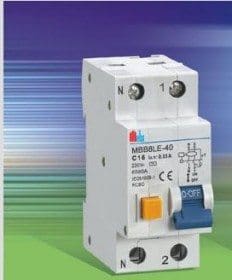
CHARACTERISTICS
- Phase (line), Neutral and Earth wire connected through ELCB.
- ELCB is working based on Earth leakage current.
- Operating Time of ELCB:
- The safest limit of Current which Human Body can withstand is 30ma sec.
- Suppose Human Body Resistance is 500Ω and Voltage to ground is 230 Volt.
- The Body current will be 500/230=460mA.
- Hence ELCB must be operated in 30maSec/460mA = 0.65msec
RCBO (Residual Circuit Breaker with OverLoad)
- It is possible to get a combined MCB and RCCB in one device (Residual Current Breaker with Overload RCBO), the principals are the same, but more styles of disconnection are fitted into one package
Difference between ELCB and RCCB
- ELCB is the old name and often refers to voltage operated devices that are no longer available and it is advised you replace them if you find one.
- RCCB or RCD is the new name that specifies current operated (hence the new name to distinguish from voltage operated).
- The new RCCB is best because it will detect any earth fault. The voltage type only detects earth faults that flow back through the main earth wire so this is why they stopped being used.
- The easy way to tell an old voltage operated trip is to look for the main earth wire connected through it.
- RCCB will only have the line and neutral connections.
- ELCB is working based on Earth leakage current. But RCCB is not having sensing or connectivity of Earth, because fundamentally Phase current is equal to the neutral current in single phase. That’s why RCCB can trip when the both currents are deferent and it withstand up to both the currents are same. Both the neutral and phase currents are different that means current is flowing through the Earth.
- Finally both are working for same, but the thing is connectivity is difference.
- RCD does not necessarily require an earth connection itself (it monitors only the live and neutral).In addition it detects current flows to earth even in equipment without an earth of its own.
- This means that an RCD will continue to give shock protection in equipment that has a faulty earth. It is these properties that have made the RCD more popular than its rivals. For example, earth-leakage circuit breakers (ELCBs) were widely used about ten years ago. These devices measured the voltage on the earth conductor; if this voltage was not zero this indicated a current leakage to earth. The problem is that ELCBs need a sound earth connection, as does the equipment it protects. As a result, the use of ELCBs is no longer recommended.
MCB Selection
- The first characteristic is the overload which is intended to prevent the accidental overloading of the cable in a no fault situation. The speed of the MCB tripping will vary with the degree of the overload. This is usually achieved by the use of a thermal device in the MCB.
- The second characteristic is the magnetic fault protection, which is intended to operate when the fault reaches a predetermined level and to trip the MCB within one tenth of a second. The level of this magnetic trip gives the MCB its type characteristic as follows:
Type Tripping Current Operating Time Type B 3 To 5 time full load current 0.04 To 13 Sec Type C 5 To 10 times full load current 0.04 To 5 Sec Type D 10 To 20 times full load current 0.04 To 3 Sec - The third characteristic is the short circuit protection, which is intended to protect against heavy faults maybe in thousands of amps caused by short circuit faults.
- The capability of the MCB to operate under these conditions gives its short circuit rating in Kilo amps (KA). In general for consumer units a 6KA fault level is adequate whereas for industrial boards 10KA fault capabilities or above may be required.
Fuse and MCB characteristics
- Fuses and MCBs are rated in amps. The amp rating given on the fuse or MCB body is the amount of current it will pass continuously. This is normally called the rated current or nominal current.
- Many people think that if the current exceeds the nominal current, the device will trip, instantly. So if the rating is 30 amps, a current of 30.00001 amps will trip it, right? This is not true.
- The fuse and the MCB, even though their nominal currents are similar, have very different properties.
- For example, For 32Amp MCB and 30 Amp Fuse, to be sure of tripping in 0.1 seconds, the MCB requires a current of 128 amps, while the fuse requires 300 amps.
- The fuse clearly requires more current to blow it in that time, but notice how much biggerboth these currents are than the ’30 amps’ marked current rating.
- There is a small likelihood that in the course of, say, a month, a 30-amp fuse will trip when carrying 30 amps. If the fuse has had a couple of overloads before (which may not even have been noticed) this is much more likely. This explains why fuses can sometimes ‘blow’ for no obvious reason
- If the fuse is marked ’30 amps’, but it will actually stand 40 amps for over an hour, how can we justify calling it a ’30 amp’ fuse? The answer is that the overload characteristics of fuses are designed to match the properties of modern cables. For example, a modern PVC-insulated cable will stand a 50% overload for an hour, so it seems reasonable that the fuse should as well.


