AmmeterAn ammeter is an instrument for measuring the electric current in amperes in a branch of an electric circuit. It must be placed in series with the measured branch, and must have very low resistance to avoid significant alteration of the current it is to measure. By contrast, an voltmeter must be connected in parallel. The analogy with an in-line flowmeter in a water circuit can help visualize why an ammeter must have a low resistance, and why connecting an ammeter in parallel can damage the meter. Modern solid-state meters have digital readouts, but the principles of operation can be better appreciated by examining the oldermoving coil meters based on galvanometer sensors.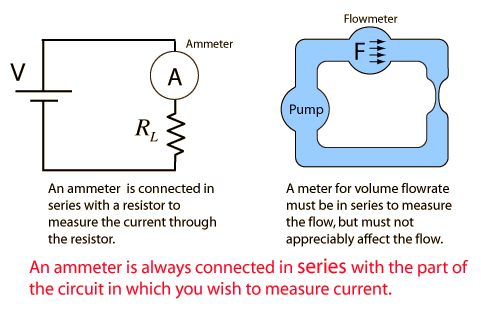
| Index DC Circuits | |

WE'LL HELP YOU OWN YOUR ELECTRICAL SUPPLIES..HELP YOU ON YOUR ELECTRICAL PROJECT AND CONCERNS......... ATTENTION!!! ALL ELECTRICAL MANUFACTURER PRODUCTMANUFACTURER AROUND THE WORLD..YOU CAN PARTNER WITH US AND WE'LL OFFER YOUR ELECTRICAL CABLES/PRODUCTS HERE IN THE PHILIPPINES......YOU CAN EMAIL US SAFEELECTRICAL2000@GMAIL.COM ELECTRICALSAFETY2019@GMAIL.COM OR thru VIBER: 09227192434 MESSENGER: m.me/jigzsafeelectrical THANK YOU MOBILE#09227192434..09454459221 landline: 63 02 79712332
Showing posts with label ELECTRICAL SAFETY. Show all posts
Showing posts with label ELECTRICAL SAFETY. Show all posts
Monday, September 9, 2013
AMMETER...WHAT YOU SHOULD KNOW...for your philippine electrical concerns...needs...installation...orders...safeelectrical2013@gmail.com

Monday, September 2, 2013
ELECTRICAL FENCE..17 MISTAKES TO AVOID...for your philippine electrical concerns...needs...installation...orders...safeelectrical2013@gmail.com
| Sustainable Farming Connection |
| Where farmers find and share information. |
17 Mistakes To Avoid With
Electric Fencing
By Wayne Burleson email: rutbuster1@mcn.net
With 30 years of experience building hundreds of miles of smooth-wire electric fence, I've seen just about every fencing mistake possible. And I continue to see folks make many of the same common mistakes. I still make mistakes myself, because I'm constantly challenging myself to make fencing easier, faster, stronger, and safer.
High-tensile, smooth wire, electric fencing is the fastest and most affordable fence that I know about, and its technology has drastically improved over the past 10 years. But many folks are hesitant to use it because they remember old failures -- wires breaking, chargers starting fires, wet vegetation shorting out the fence and other troubles.
With a little commitment and a modest investment in time to learn how to use this new technology, you can save thousands of dollars and hours of maintenance time by making electric fencing work for you. So you won't have to learn the hard way, here are 17 common mistakes that you should avoid:
 Poor earth grounding. Lots of folks (including me) still think you can skimp when it comes to adequate earth grounding. What we must all learn to do, is install several ground rods -- at least three that are 6 to 8 feet long, galvanized, and attached with good ground clamps. The electricity must complete a full circle back to the charger through the ground. Poor grounding gives weak shocks.Using different types of metals. Don't do it. When you hook up steel wire to copper something call electrolysis happens and the metal becomes corroded, making a poor contact and weakening shocking power.Inadequate animal training. Each and every animal must learn that the fence hurts. So please build a handy training fence, preferably on heavy wet soil. Flag the fence for visibility, and force the animal to try and cross the fence.Fenceposts too close together. Well-intended government agencies recommend lots of fenceposts in their fencing specifications. Fifty-foot spacing on flat land is just too close. You want the fence to act like a rubber band. When something runs into the wire, you don't want to break all the insulators or knock posts out of the ground. If the posts are spread apart far enough -- say 80 to 100 feet -- the wire will just bend to the ground and pop back up.Too many wire tie-offs. Again, fencing specifications may call for braces every quarter mile wire to tie the wire off. But I have found that even 5,000 feet is OK, and actually adds more elasticity in the fence wire. This reduces the chance of wires breaking.Wires tied tight to each fencepost. To maintain elasticity (the rubber band effect), wires must float past each line fencepost.Building new fences near old existing fences. Old fence wires seem to be always moving somewhere and coming in contact with the new electrified wires. This almost always causes a complete short in the fence, and away the animals go.Bottom wire in contact with heavy, wet vegetation. Wet grass will suck lots of juice out of any fence charger. Hook up the lower wires separate from the other wires, and install a switch for the lower wires that you can turn them off when the grass is tall.Poor-quality insulators. Be careful here. Sunlight deteriorates plastic. So buy good-quality, long-lasting insulators. Usually black ones are treated to resist degradation by ultraviolet light. I have found that poor quality insulators turn white or clear after a few years in direct sunlight.Staples driven in all the way. When using plastic tubing as an insulator, don't staple it too tight. I once spent several hours trying to find a short in a gate. Finally, I discovered a staple had damaged the tubing next to a ground wire, causing a hidden short.Solar panels not directly facing the sun. This seems almost too obvious to be a problem. But a solar panel won't function at its potential if not properly installed. Please read the instructions. Don't just guess if you have done it right.Kinks in high-tensile wire. A small kink in stiff wire will always break. Also avoid hitting this kind of wire with a hammer, as this will easily damage the wire causing a break. Always cut out a damaged section of high tensile wire and splice it. Incidentally, I have found that a hand-tied square knot makes the strongest splice.Installing in-line strainers close together. Wires will flip together once in awhile. If in-line strainers are installed one above the other, they will sometimes hook up. Separate in-line strainers by a fencepost and they will never catch on each other.Wires too close to each other. Keep them at least 5 inch apart.No voltmeter. Without a voltage meter to check how hot a fence is, you're just guessing.Wire too small. The larger the wire, the more electricity it will carry. Don't skimp.Inadequate charger. A wimpy fence charger gives you a wimpy fence. Don't skimp here because animals will think a smooth wire fence is a joke without a strong bite, and they'll walk right through it.
Your fence charger should be low-impedance, come from a dependable supplier, and have a warranty and replaceable components. Please buy one that puts out lots of power. During a rainy year, you may have lots of plant growth touching the wires. That's when you will need extra power to shock through the heavy, wet vegetation. It's also handy to find folks with an extra charger they can loan to you while yours is being repaired. Expect some breakdowns, especially from lightning. Certain fence suppliers offer lightning protection with their warranties.
Don't be afraid to try electric smooth wire fencing. Find a good fence suppler and learn some of the tricks of the trade. I know folks who hate electric fencing. But their pocketbook is not big enough to build a conventional fence, which may cost up to $1 per foot.
The next time your bulls get in a fight with the neighbors bulls and tear down all the fence, remember that most animals will learn not to touch a wire with 5,000 volts running thorough it.
Wayne Burleson is a range management consultant form Absarokee, Montana, and the author ofRutbuster! which describes a western, "you-can-do-it" way on how to get out of life's daily ruts.
FOR YOUR PHILIPPINE ELECTRICAL CONCERNS...NEEDS...INSTALLATION...QUOTATION...ORDERS
KINDLY EMAIL US: SAFEELECTRICAL2013@GMAIL.COM
FOR YOUR PHILIPPINE ELECTRICAL CONCERNS...NEEDS...INSTALLATION...QUOTATION...ORDERS:
KINDLY EMAIL US: SAFEELECTRICAL2013@GMAIL.COM
Sunday, September 1, 2013
ELECTRICAL SAFETY AROUND THE HOME...WHAT YOU SHOULD KNOW...for philippine electrical concerns..inquiries and orders: email us: SAFEELECTRICAL2013@GMAIL.COM
Electrical Safety Around the Home
 Safety around electricity is important to avoid electrical shocks, overheating, or worse, a fire. Guelph Hydro offers these tips to keep you, your family and friends safe in your home.
Home Safety Planning Calendar
Plan ahead for home safety.

Print and use this calendar (as seen above) to ensure a monthly electricity check becomes part of your regular home safety maintenance schedule.
- Make sure that any electrical device you use is approved by the Canadian Standards Association (CSA) or Underwriters Laboratories of Canada (ULC).
- Unplug any electrical devices when they are not in use.
- Don't place any electrical appliance near water, such as a sink or bathtub. When not in use, unplug any appliances that are used near water. If you have an appliance that has gotten wet, unplug it and don't use it until it has been checked by a qualified repair person.
- If something gets stuck in an appliance, such as a piece of bread in a toaster, always unplug the appliance before removing the object. Never use a metal tool to remove it.
- Always unplug electrical devices when changing an attachment, such as a light bulb in a lamp.
- Never stand on a wet floor when using an electrical device.
Cords and plugs
- When pulling a plug out of an outlet, pull on the plug, not the cord.
- When using a grounded (three-prong) plug, never break off or bypass the third prong (ground).
- Make sure cords are out of traffic areas and that furniture is not resting on them. Do not run electrical wires through doorways or hide them under rugs or carpets. Doors closing on cords or the weight and friction caused by people walking over the rug can damage the cord's insulation, increasing the risk of fire or electric shock.
- Replace cracked or worn extension cords with new ones.
- Don't use staples or nails to attach extension cords to a baseboard or to another surface. This could damage the cord and present a shock or fire hazard.
- Check the plug and the body of the extension cord while the cord is in use. Some warming is expected when cords are being used, but if the cord feels hot or if there is a softening of the plastic, this is a warning that the plug wires or connections are failing and that the extension cord should be discarded and replaced.
- Keep all cords away from heat and water. Never use a plug when your hands are wet or when you are touching a metal object.
Outlets
- Check outlets for loose-fitting plugs, broken wall plates, and overloading. Make sure there are safety covers on all unused outlets that are accessible to children.
- If there are repairs needed for any electrical outlets in your home, Guelph Hydro recommends that you hire a qualified electrician to ensure new outlets and wiring are up to code. To find a qualified electrician, please visit the Electrical Safety Authority website.
Light bulbs
- Ensure light bulbs are screwed in securely and are the correct wattage for the fixture.
- Compact fluorescent light bulbs must be disposed of properly.
Keeping children safe
- Keep children safe by covering electrical outlets with child-proof outlet covers, and teach them early that electrical devices are not toys.
Portable space heaters
Portable electric space heaters are often used by employees to provide additional heat during the colder months. Unfortunately, space heaters also increase the risks of fire and electric shock if they are not used properly.
Guelph Hydro recommends that employers educate employees about safe space heater practices to reduce the risks to employees and facilities.
- Employees should be required to obtain approval from a supervisor or facility manager prior to using a space heater at work.
- All space heaters should have the certification of either Underwriters Laboratories of Canada (ULC) or be Canadian Standards Association (CSA) approved, or both.
- Keep heaters at least three feet away from anything that can burn, including papers, clothing and rugs.
- Keep space heaters out of high traffic areas and doorways where they may pose a tripping hazard.
- Plug space heaters directly into a wall outlet. Do not use an extension cord or power strip, which could overheat and result in a fire.
- Do not plug any other electrical devices into the same outlet as the heater.
- Operating space heaters should never be left unattended. They should be turned off and unplugged at the end of the work day or whenever the employee leaves the room.
Treating electric shock
- If electric shock does occur, follow the steps listed below to ensure you and anyone in the area stay safe.
Outdoor (high voltage) electricity
- Call 9-1-1.
- Do NOT touch the person.
- Do NOT try to use a tool to free the person.
Indoor (low-voltage/100 Volts) electricity
- Call 9-1-1.
- Don't touch anyone who is in contact with an energized circuit.
- Switch off power at the fuse or circuit-breaker box, or pull the plug.
- Call Guelph Hydro at 519-822-3017 if you cannot get the power shut off.
FOR PHILIPPINE ELECTRICAL INQUIRIES CONCERNS AND ORDERS:
EMAIL US: SAFEELECTRICAL2013@GMAIL.COM
FOR PHILIPPINE ELECTRICAL INQUIRIES CONCERNS AND ORDERS:
EMAIL US: SAFEELECTRICAL2013@GMAIL.COM
Subscribe to:
Posts (Atom)